
Website designed with the B12 website builder. Create your own website today.
Start for free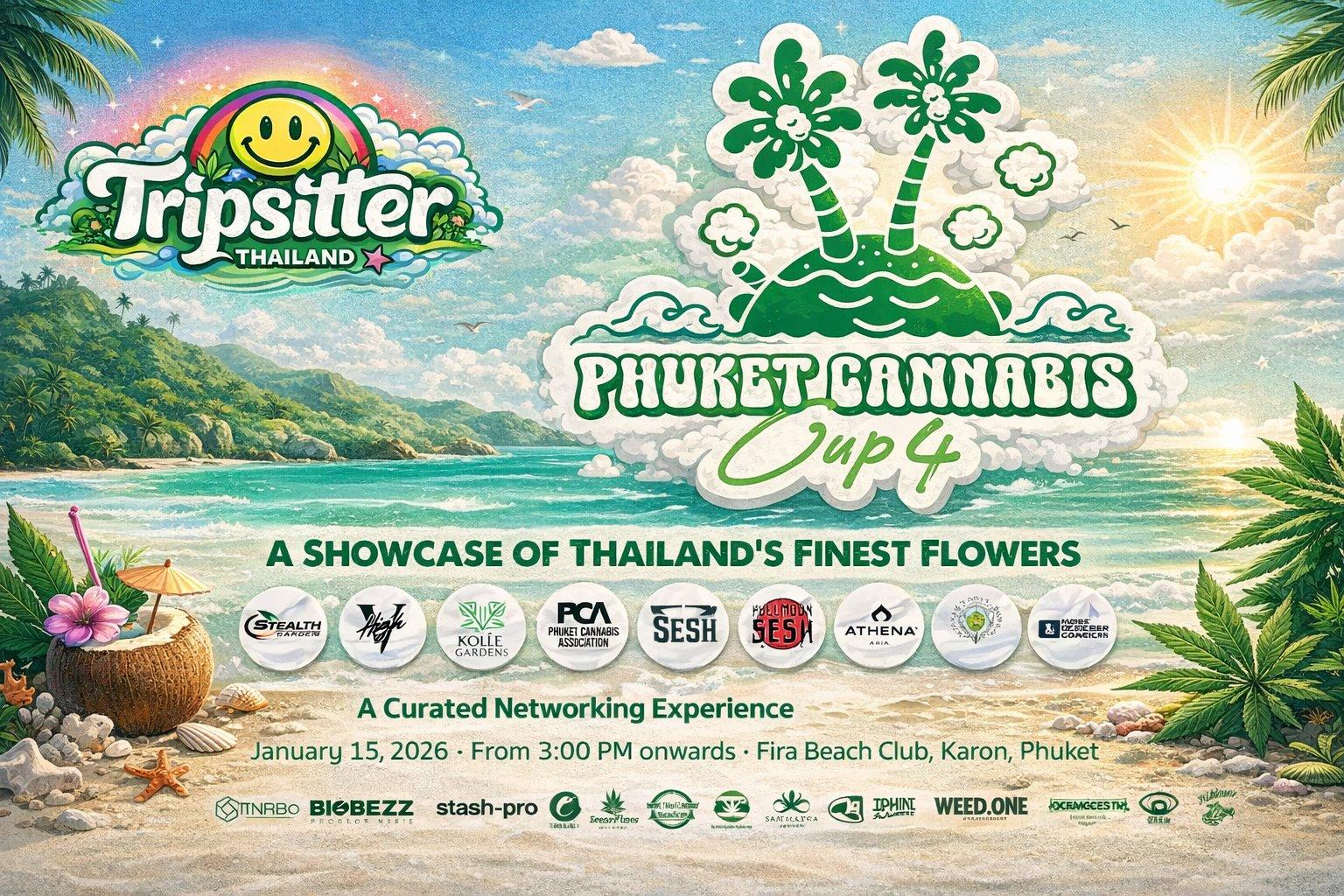
Phuket, Thailand —
Cannabis festivals have long existed beyond the surface of celebration. They are living reflections of how societies negotiate their relationship with a powerful plant that has oscillated between reverence, prohibition, and commercialization. From ancient ceremonial gatherings to contemporary cultural platforms, cannabis festivals represent humanity’s ongoing attempt to reconcile knowledge, responsibility, and freedom.
Historically, cannabis was never merely a recreational substance. Across Asia, Africa, and the ancient world, it functioned as medicine, spiritual catalyst, and cultural companion. Its later criminalization fragmented this relationship, pushing centuries of wisdom underground. Modern cannabis festivals emerged as a response to that rupture — not to glorify intoxication, but to reopen dialogue in public space, where secrecy is replaced with education and silence with accountability.
As global attitudes toward cannabis shift, festivals have evolved into structured forums for knowledge exchange, cultural expression, and industry dialogue. They occupy a unique position between regulation and freedom, commerce and conscience. In a world where cannabis legalization often advances faster than ethical frameworks, festivals have become social laboratories — places where society tests whether progress can occur without repeating old mistakes.
These gatherings attract a diverse spectrum of participants: cultivators, medical professionals, researchers, policymakers, entrepreneurs, artists, and conscious consumers. What unites them is not consumption, but inquiry — a shared willingness to ask how cannabis should exist within modern society.
Within this broader movement, the Phuket Cannabis Cup has emerged as a defining event in Thailand’s cannabis landscape. Set against the global crossroads of Phuket, the Cup has grown from a small, community-led gathering into an international meeting point for Southeast Asia’s cannabis ecosystem.
More than a competition, the Phuket Cannabis Cup functions as a cultural mirror. It reflects Thailand’s complex relationship with cannabis — one shaped by traditional knowledge, medical potential, economic opportunity, and unresolved social tension. Here, growers exchange insights with scientists, entrepreneurs listen to patients, and conversations unfold beyond branding and marketing.
By limiting attendance and prioritizing meaningful interaction, the event fosters authentic dialogue and long-term collaboration rather than spectacle.
Thailand’s cannabis journey reveals both promise and contradiction. On one side lies genuine healing potential — pain relief, mental health support, and alternative medicine. On the other, rapid commercialization risks reducing a culturally significant plant into another disposable product.
Retail expansion has often outpaced education. Marketing language has moved faster than scientific literacy. These tensions are not failures of cannabis itself, but symptoms of a society still learning how to integrate freedom with responsibility.
Cannabis festivals, when curated with intention, offer a corrective space — slowing the pace, grounding discussion, and reminding participants that culture must mature alongside markets.
As cannabis festivals continue to evolve, their relevance will depend on the depth of substance they carry. Beyond exhibitions and awards, they must address essential questions:
Looking ahead, Thailand stands at a crossroads. The future may follow a purely market-driven model, a tightly controlled regulatory path, or a culturally integrated approach balancing economic growth with ethical stewardship. Events like the Phuket Cannabis Cup sit precisely at this intersection.
The sustainable development of cannabis culture in Thailand will depend on cooperation across regions and sectors. Festivals provide neutral ground for collaboration — linking northern agricultural expertise, northeastern community farming models, central processing and logistics, and southern tourism and international exchange.
By fostering partnerships between private enterprises, researchers, healthcare professionals, and local communities, cannabis festivals can function as infrastructure for shared standards, innovation, and responsible growth.
At their core, meaningful cannabis festivals are not about excess, but intention. They are modern ceremonies where participants are invited to listen as much as they speak, to learn as much as they trade, and to recognize their role in shaping what comes next.
When gathering becomes ritual, participants are no longer consumers. They become stewards.
And the question these festivals ultimately pose is not whether cannabis belongs in society — but whether society is ready to carry it with care.
ได้เลยครับ นี่คือ คำปิดท้าย (Closing Statement / Post-Event Message)
โทนอบอุ่น จริงจัง มีวิสัยทัศน์ และทิ้งคำถามไว้กับอนาคต เหมาะสำหรับโพสต์สรุปงาน เว็บไซต์ หรือสื่อพาร์ตเนอร์
Phuket Cannabis Cup 4 has now come to a close.
What unfolded was more than a festival.
It was a convergence of people who chose presence over performance, conversation over noise, and responsibility over hype.
For one day by the beach, growers, researchers, medical operators, judges, entrepreneurs, and conscious seekers met face-to-face. Ideas were exchanged without algorithms. Partnerships began without marketing scripts. Questions were asked that cannot be answered in a single event — only carried forward.
This year was not about expansion.
It was about alignment.
Alignment between quality and integrity.
Between culture and industry.
Between where Thai cannabis stands today and where it may be heading next.
As the lights dim and the conversations echo back into daily life, one truth remains clear: the future of cannabis in Thailand will not be shaped by trends alone, but by the people willing to protect its depth, ethics, and meaning.
We thank every participant who came not just to attend, but to contribute.
And as we turn our gaze toward the next chapter, we leave you with an open question:
What should the next evolution of Thai cannabis culture look like?
We invite you to reflect, to stay engaged, and to follow the journey toward Phuket Cannabis Cup 5 — where the direction may shift, the dialogue may deepen, and the culture will continue to grow.
Until next year,
by the same sea,
with new questions,
and greater responsibility 🌊🌿
—
Tripsitter Thailand
Not just cannabis. It’s a culture.